The next time a driver waits to merge until the very last moment in heavy traffic, try to keep your cool. They’re doing us all a favor.
The “late merge” or “zipper merge” method is encouraged by many transportation officials and is an official policy in some states, including Utah, Illinois, North Carolina and Ohio.
This video from the Motor Association in Alberta, Canada, illustrates how and when this approach works best.
When traffic is flowing normally, drivers should merge whenever it makes sense. In moderate to heavy traffic and when there are lane closures, however, late merging is the best way to prevent further backups and accidents.
Experts point out that when drivers merge at the end of the lane and (politely) allow others to do the same, traffic flows more smoothly because more lane space is utilized.
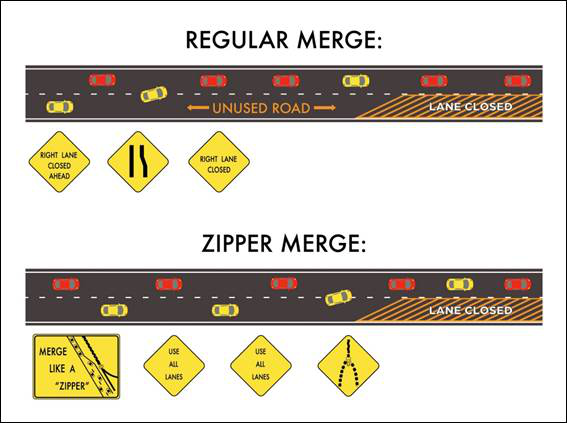
Early merging, on the other hand, can cause sudden slowdowns and increase the risk of accidents because drivers often slam on their brakes and block open lane space.
Research by the Colorado Department of Transportation shows that zipper merging can cut delays by up to 40% in congested areas.
“It does take some cooperation, but it maximizes road space and helps keep things moving,” says Kurt E. Gray, a director of driver training with AAA.
Despite the research, California has yet to formally get behind it.
“Caltrans is aware of the ‘zipper merge,’ but we are not studying or researching it. We are not promoting it to the public,” a Caltrans spokesperson told KTLA.